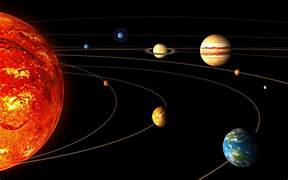
Each planet like a ball,
Rounds as a child of the sun,
Mercury is smallest,
But also closest;
Very fast too,
Venus the twin;
Of the earth,
In the birth;
With no moons,
Earth is blue,
Water is the clue,
Mars is red;
It has water,
Even though hotter,
Whose atmosphere is thin,
The fifth is jupiter,
The largest one than neptune;
It’s a gas giant,
92 moons,
Galilian moons by;
With galilio’s effort,
The planet of rings,
With 274 moons,
Even though darkness;
First in the telescope,
By William’s hope,
Also second large planet,
Uranus follows the sun;
Has 27 moons,
The blue-green planet,
With a special icy mantle,
Rock outermost;
The planet from the sun,
Only one moontriton
The farthest planet,
And the coldest too…
details about this poem
1. Theme
The poem is about the solar system and the planets revolving around the sun.
It introduces each planet with its special features, moons, and scientific facts.
2. Subject & Idea
- Subject: Planets of our solar system.
- Main Idea: To describe the planets one by one (in order of distance from the Sun) and highlight their uniqueness.
3. Structure
- Written in short rhyming lines.
- Moves sequentially through the planets (Mercury → Venus → Earth → Mars → Jupiter → Saturn → Uranus → Neptune).
- Ends with the farthest planet Neptune, making it complete and systematic.
4. Poetic Devices
- Rhyme: “sun / one”, “blue / clue”, “thin / in”.
- Imagery: “Earth is blue, water is the clue”, “Mars is red”, “blue-green planet Uranus”.
- Personification: Planets described almost like living beings (child of the sun, planet of rings).
- Symbolism: Colors and features used as symbols –
- Mercury = speed, closeness.
- Venus = Earth’s twin.
- Earth = life, water.
- Mars = red planet.
- Jupiter = giant, moons.
- Saturn = rings.
- Uranus = tilted, icy.
- Neptune = coldest, farthest.
- Allusion: Mentions Galileo (discovering Jupiter’s moons) and William Herschel (discovering Uranus).
5. Tone & Mood
- Tone: Informative + descriptive.
- Mood: Curious, explorative, almost like a child learning about the universe with excitement.
6. Type of Poem
- Can also be called a science poem or educational verse.
7. Moral / Purpose
- To make learning about planets easy and fun through poetry.
- To show that each planet is unique but still part of one solar family.
✨ In short:
This is an educational nature-science poem that describes all eight planets of the solar system, using rhyme, imagery, and facts, making astronomy simple and enjoyable.